A complete aerosol filling line is not simply one filling machine. For commercial production, several stations must work together in the correct sequence—from product filling and valve sealing to propellant charging, leak testing, final assembly and packing.
The exact line configuration depends on your targeted aerosol product and formulation, required production capacity, can and valve specifications, propellant type, quality-control protocols, downstream packaging requirements, workshop layout, and overall required level of automation.
This guide focuses on one practical question: What equipment should actually be included in a complete aerosol filling line? If you are still deciding which capacity and automation level are suitable for your project, read our guide on how to choose an aerosol filling machine. For complete production-line options, explore AILE's aerosol filling lines.
1. The Core Aerosol Filling Process
For a conventional aerosol product, the core filling process normally consists of four stages:
- Liquid filling
- Valve placing
- Valve crimping
- Propellant filling
Automatic production lines use conveyors to connect these stages and maintain a continuous production flow. A complete production sequence typically follows this engineering route:
Empty Can → Liquid Filling → Valve Placing → Valve Crimping → Propellant Filling → Leak Testing → Checkweighing → Actuator / Cap Pressing → Coding → Packing
The first four stages form the basic filling process. The remaining stations are selected according to the customer's inspection, packaging and automation requirements.
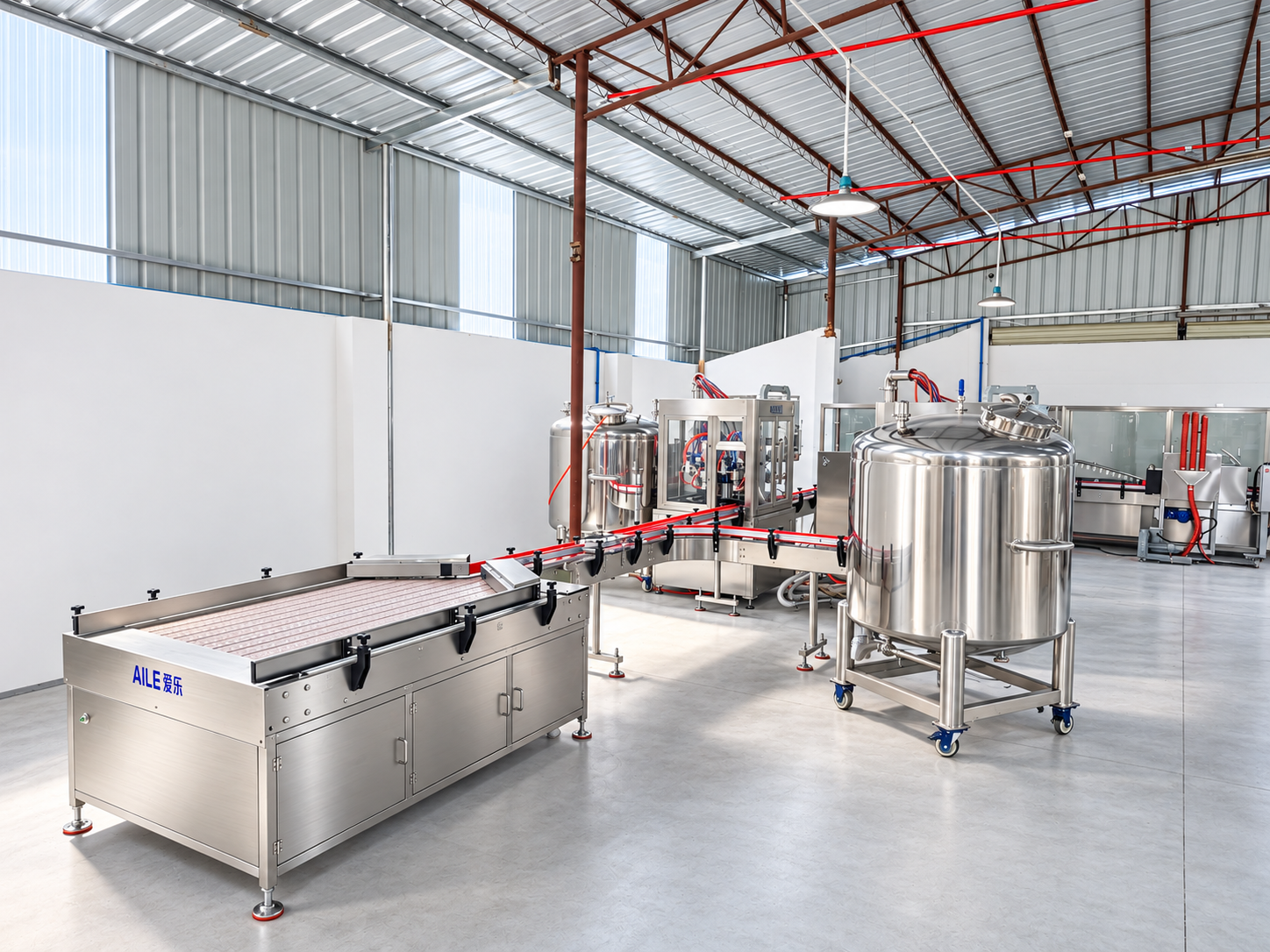
Core Filling Equipment
2. Liquid Filling Machine
The liquid filling machine doses the product formulation into the empty aerosol can before the valve is sealed. Its configuration depends directly on product viscosity, filling volume, required output, number of filling heads, and specific formulation traits.
Different formulations require different metering designs:
- Lubricant aerosols: May vary significantly in viscosity and additive stability.
- Shaving foam: Requires a filling configuration suitable for soap concentrate emulsions.
- Spray paint: Demands continuous liquid agitation to keep pigment uniformly dispersed.
- Personal-care sprays: Requires high-precision dosing pumps for stable and repeatable volumes.
For this reason, liquid filling equipment should be selected according to the actual product rather than line speed alone. For special formulations, AILE recommends providing product technical sheets or actual material samples before machine fabrication.
3. Aerosol Valve Placing
After liquid filling, the aerosol valve is placed onto the can collar before crimping. Depending on the desired output, valve placing can be executed manually, semi-automatically, or via a high-speed automatic vibratory bowl feeder. For continuous automatic production, automatic valve placing reduces manual labor and helps maintain an unbroken can pitch between liquid dosing and crimping.
Standard aerosol containers typically utilize a 1-inch (25.4 mm) mounting cup, while customized micro-valves or specialty actuators can be tailored. Physical valve samples should always be tested during factory commissioning.
4. Valve Crimping Machine
The crimping station mechanically expands crimping collet jaws to lock the aerosol valve mounting cup onto the can seam. Crimping quality directly dictates seal integrity, long-term propellant retention, leakage risk, and container stability.
For a standard AILE aerosol filling configuration, typical benchmark parameters include:
- Crimping diameter: approximately 27.1–27.3 mm
- Crimping depth: approximately 5.0–5.2 mm
These figures are specific to corresponding tinplate or aluminum valve-can combinations. AILE requests customers send actual cans and valves to ensure machine tooling is calibrated around real materials rather than nominal theoretical drawings.
5. Propellant Filling Equipment
After crimping, propellant is charged through or under the valve into the can. AILE aerosol filling equipment can be configured for common propellants including LPG, DME, Nitrogen (N₂), and Carbon dioxide (CO₂).
Projects utilizing flammable propellants like LPG or DME require strict explosion-proof engineering, including intrinsically safe pneumatic controls and ATEX-compliant drive systems. AILE delivers turnkey certified explosion-proof configurations. For standalone operations, see our dedicated aerosol propellant filling machine.
6. Conveyor and Line Coordination
In a fully automatic line, motor-driven slat conveyors synchronize processing stations. Stations must act as an integrated unit to avoid line starvation or bottle jams. While a standard straight-line setup can stretch approximately 21 meters, AILE frequently engineers compact U-shaped or L-shaped layouts to accommodate existing factory footprints.
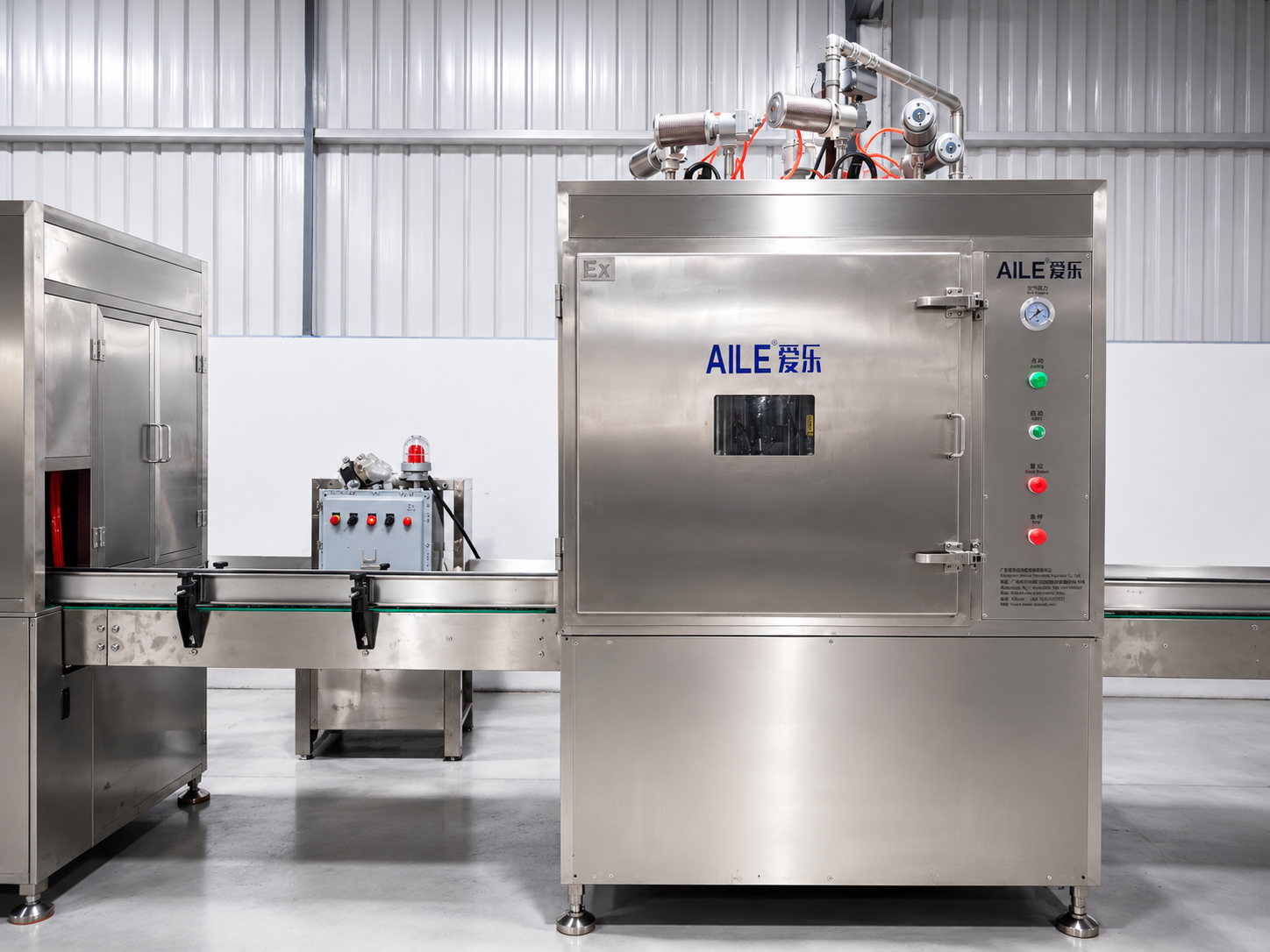
Quality-Control Equipment
7. Hot Water Bath Leak Testing
Because finished aerosol containers are pressurized, leak testing is vital for consumer safety and international transport compliance (such as ADR and DOT regulations). Filled cans are submerged in a temperature-controlled bath (commonly reaching ~50°C depending on standards) while internal pressure rises to expose microscopic valve or seam leaks.
Integrating a water bath tester affects overall line length, electrical and hot-water utility load, and floor space, making early planning essential.
8. Online Checkweigher
An online checkweigher continuously screens every finished unit downstream of propellant charging. Cans deviating from strict high/low tolerances are automatically rejected off the line, ensuring liquid dosage accuracy and verifying correct gas charge weights.
Downstream Packaging Equipment
9. Actuator Pressing & 10. Cap Pressing
Once containers pass quality inspection, automatic actuator sorting bowls and pneumatic pressing heads install the spray nozzle without triggering unintentional discharges. Immediately downstream, an automatic overcap placer seats protective plastic caps.
11. Coding & 12. Extension Straw Application
Continuous inkjet (CIJ) or laser coding systems imprint lot numbers, manufacturing dates, and QR traceability codes onto the concave can bottom. For technical lubricants and penetrant sprays, automated straw-attaching machines tape or clip red extension tubes onto the can exterior.
13. End-of-Line Packing
Finished sprays collect onto rotary accumulation turntables, semi-automatic packing stations, or automatic cartoning and shrink-wrapping machinery according to labor requirements.
Which Equipment Is Essential and Which Is Optional?
A structured approach to planning your aerosol line involves segregating machinery by operational tier:
| Station Category | Typical Equipment | Main Function | Typical Role |
|---|---|---|---|
| Core Filling Process | Liquid filler, valve placing system, crimping machine, propellant filler | Product dosing, valve sealing, and propellant charging | Core Equipment (Mandatory) |
| Conveying & Coordination | Conveyor tracks, turntables, star-wheel indexing transfers | Connects stations and maintains synchronized flow | Required for Automatic Lines |
| Quality Control | Hot water bath leak tester, online checkweigher | Validates structural pressure integrity and fill accuracy | Configured by compliance & QC demands |
| Downstream Packaging | Actuator presser, cap presser, coder, straw applicator | Completes aesthetic and functional can assembly | Product-specific / Modular |
| End-of-Line Handling | Accumulation conveyors, case packers, wrapping tables | Transfers and packs finished goods into shipper cartons | Optional depending on labor targets |
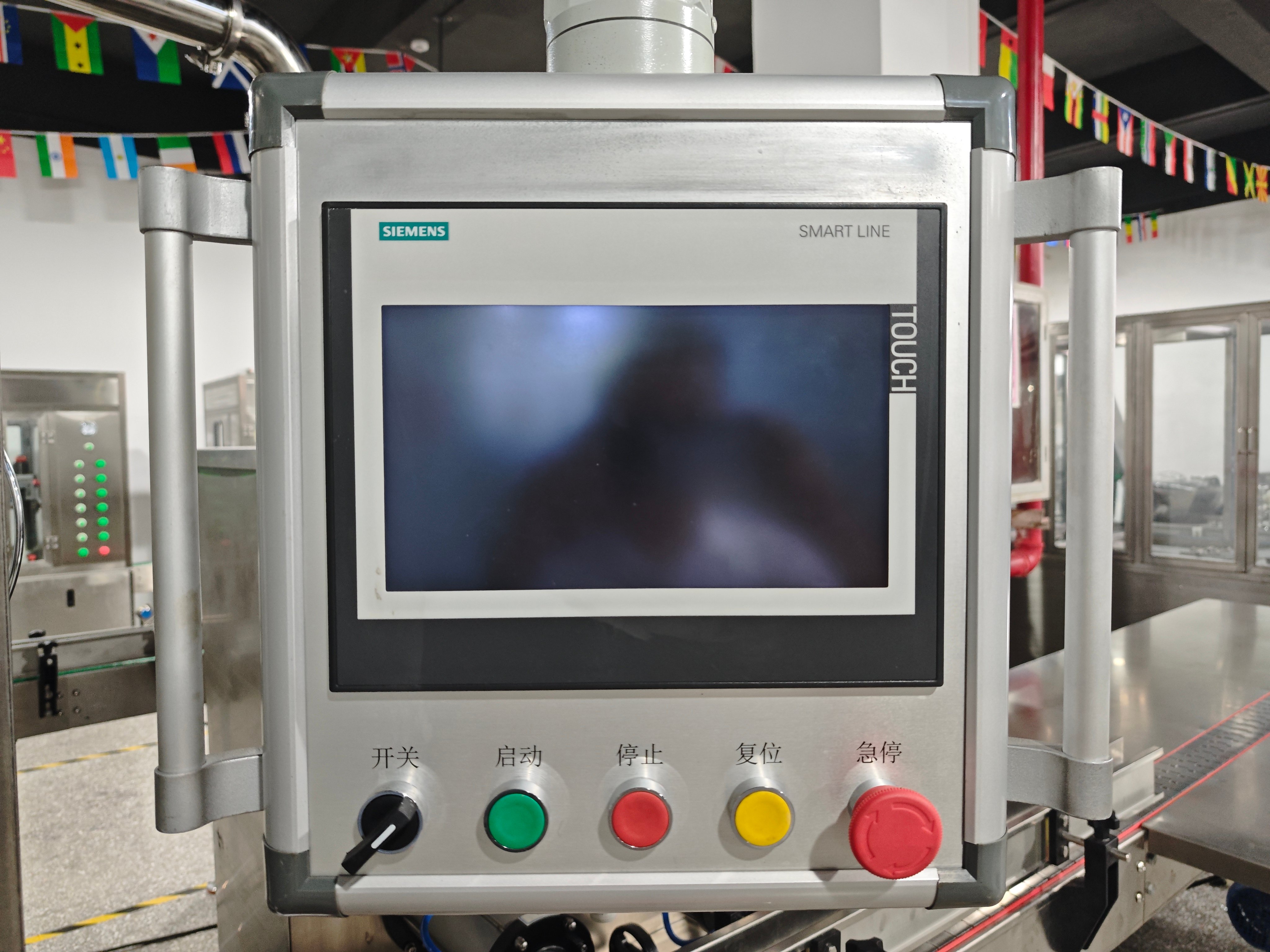
Typical Line Configurations & Capacities
Semi-Automatic Production
Combines manual valve placing with pneumatic table-top stations. Delivers 500–700 cans/hour at 0.6–0.8 MPa operating pressure and ~0.6 m³/min air consumption. Ideal for pilot batches, lab formulations, and high-mix low-volume operations.
Standard Automatic Production Line
Incorporates synchronized conveyors, multi-head rotary liquid fillers, automatic crimpers, and gassing units. Delivers 2,400–3,600 cans/hour across standard can diameters (35–70 mm) and heights (80–300 mm).
High-Speed Production Lines
Multi-index rotary indexing tracks and multi-head propellant charging deliver 4,800–7,200 cans/hour. Note that while individual liquid dosing modules can cycle at 100–120 cans/minute (CPM), complete end-to-end line output is governed by total system integration.
Product-Specific Equipment Requirements
- Lubricant Aerosols: Require integrated solvent dosing, water bath testing, and automated red extension straw taping.
- Spray Paint: Demands stainless steel glass ball insertion units and continuous agitation reservoirs to prevent paint sedimentation.
- Bag-on-Valve (BOV) Products: Propellant (compressed air or N₂) is charged under-the-cup first, followed by active liquid filling directly into an internal four-layer laminate bag. Explore AILE's specialized Bag-on-Valve filling machine.
- MDI Medical Inhalers: Demands pharmaceutical cleanroom compliance, ultra-precise metering valves, and specialized micro-dose charging.
Workshop Space and Facility Planning
A full 21-meter straight automatic line requires at least 100 m² of dedicated workshop space. This footprint accounts for raw packaging staging, propellant storage tanks outside the main building, maintenance clearances, and explosion-proof ventilation channels. Providing your CAD workshop drawing early allows AILE engineers to configure straight, U-turn, or L-shape tracks.
Pre-Shipment Factory Acceptance Testing (FAT)
AILE strongly requests clients courier actual cans, valves, propellants, and chemical formulations to our facility prior to machine dispatch. Running physical materials verifies can starwheel alignment, collet crimp seals, actuator press fit, and net weights, backed by video verification.
Frequently Asked Questions
What equipment is essential for a standard aerosol filling line?
The core process strictly requires four sequential stages: Liquid Filling → Valve Placing → Valve Crimping → Propellant Charging. Fully automatic lines additionally require variable-speed conveyors to coordinate can flow. Safety water baths, checkweighers, and cap pressers can be added based on regulatory and output targets.
Is a hot water bath leak tester required?
For almost all commercial pressurized aerosols transported by road, rail, or sea, international dangerous goods regulations (e.g., UN/DOT guidelines) mandate hot water bath testing or an approved alternative to verify container tightness at elevated pressure. Confirming this early is crucial, as a water bath requires dedicated power, water supply, and floor space.
Can one aerosol filling line produce different products?
Yes. With interchangeable starwheels, adjustable guide rails, and modular filling nozzles, a single AILE automatic line can handle multiple can diameters (35–70 mm) and formulations. However, switching between dissimilar fluids (e.g., paint to cosmetics) requires thorough cleaning and dedicated product contact parts.
Why should I send actual cans and valves before shipment?
Even minor variations of 0.1 mm in can neck thickness or valve mounting cup profile can lead to gas leaks or seal failure. AILE uses your actual components to precision-machine the crimping jaws, collets, and starwheels, ensuring turnkey plug-and-play operation upon arrival at your plant.
Can inspection and packing equipment be added later?
Yes. AILE designs modular conveyor frameworks. If your budget initially prioritizes the core filling and crimping machinery, our engineers can leave physical space and PLC interface connections so checkweighers, coders, and case packers can be seamlessly integrated in future expansion phases.
Build the Line Around Your Real Production Needs
Do not simply assemble individual machines from a general catalog. The most profitable line balances formulation viscosity, can geometry, propellant safety, and available floor space.
Provide your target capacity, container samples, and workshop dimensions to AILE's engineering team to receive an optimized production line layout and quotation.