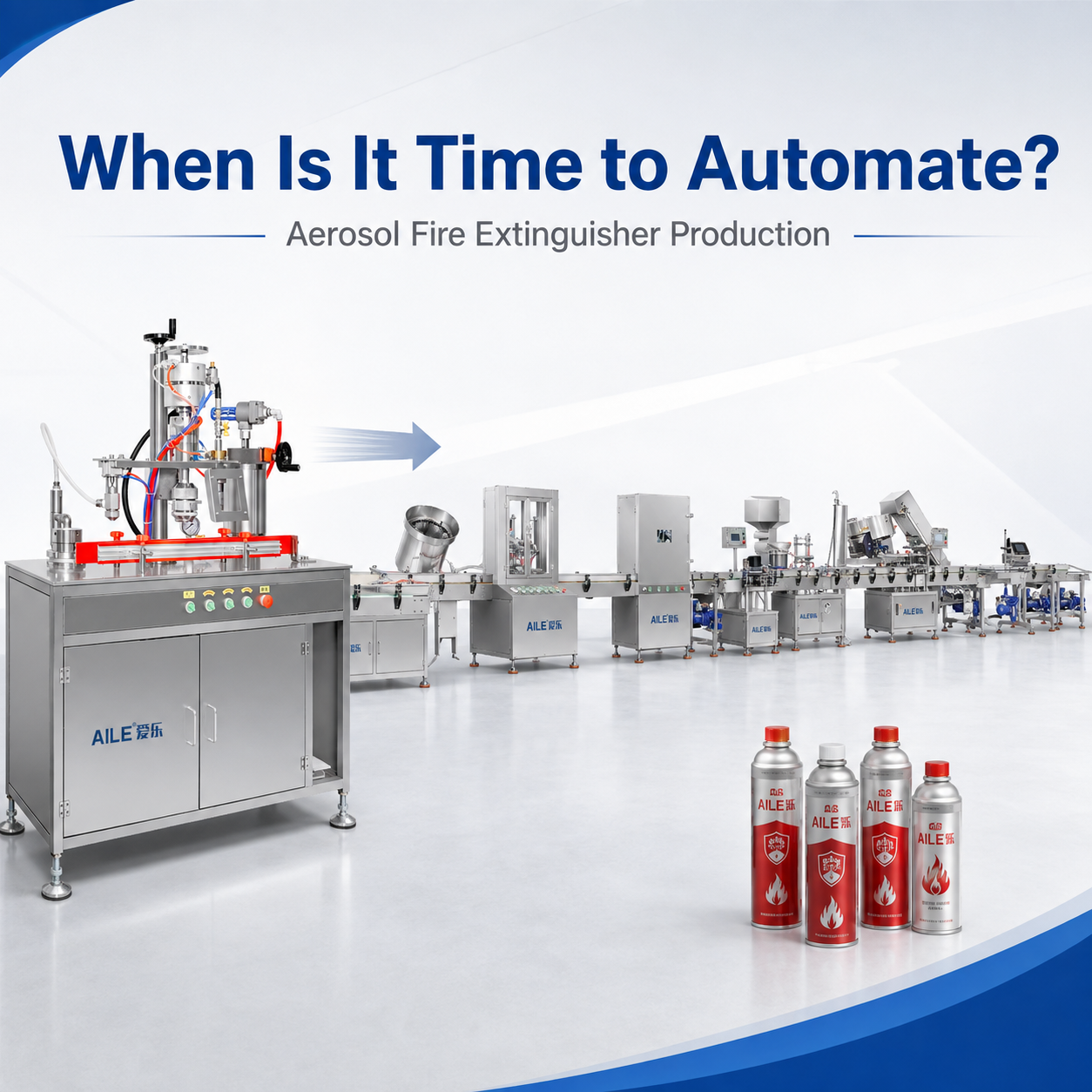
Moving from semi-automatic equipment to an automatic aerosol fire extinguisher filling line is not simply an upgrade from a “basic” machine to a “better” machine.
For some manufacturers, semi-automatic equipment remains the more practical production model for years. For others, increasing output makes manual transfer, valve handling and downstream operations increasingly difficult to manage.
The right time to automate is usually reached when the production system—not just one filling machine—starts limiting the factory's ability to meet demand consistently. Here are the factors that matter most.
1. Your Daily Production Target Has Outgrown Manual Handling
The most obvious reason to consider automation is sustained production demand. AILE's standard semi-automatic aerosol systems are generally designed for lower-output production, while automatic lines move cans continuously between major filling stages and support substantially higher throughput.
But rated machine speed should not be the only trigger. A factory producing a few large orders each month may still work efficiently with semi-automatic equipment. A manufacturer running the same product every day is more likely to benefit from continuous automatic production.
The important distinction is between occasional peak demand and stable, repeatable production demand. Buying an automatic line for a temporary order spike can create unnecessary capital investment. Automating a process that is consistently operating near its practical limit is a different situation.
2. Manual Transfer Is Becoming the Bottleneck
A semi-automatic system may have sufficient filling speed while the overall production flow remains slow. This often happens because operators still need to:
- move cans between stations
- place valves
- transfer finished cans
- coordinate inspection
- manage downstream assembly
At low production volumes, this flexibility is useful. As output increases, however, the time between stations becomes part of the production cycle. An automatic line reduces this dependence on manual movement by connecting production stages through synchronized conveying and automatic handling. That is usually a stronger reason to automate than simply wanting a machine with a higher advertised speed.
3. You Are Producing Longer Runs of the Same Product
Semi-automatic equipment is often practical when a factory produces several products in relatively small batches. Operators can stop production, change the setup and begin another SKU without needing to coordinate a long integrated line. Automatic production becomes more attractive when the factory runs:
- standardized cans
- stable valve formats
- repeat formulations
- longer production campaigns
The longer a line can operate without frequent format changes, the more useful continuous automation becomes. This is why an automatic line can make excellent sense for an established fire suppression product with predictable demand, while a contract filler handling many short production runs may still value the flexibility of a semi-automatic aerosol filling machine.
4. Labor Is Increasing Faster Than Output
Automation should not be evaluated simply as “machine cost versus worker salary.” The more important question is how labor affects production flow.
With semi-automatic production, additional output often requires more manual handling or better coordination between operators. At some point, adding people may no longer produce a proportional increase in finished cans. An automatic line can shift operators away from repetitive can transfer toward:
- line supervision
- material replenishment
- quality checks
- changeover
- finished-product handling
This does not mean a fully automatic aerosol line operates without people. Operators are still required according to the final configuration. Automation mainly changes where labor is used.
5. Production Consistency Has Become More Important Than Flexibility
A growing manufacturer may reach a stage where production consistency becomes more important than the ability to rearrange individual workstations easily. An integrated automatic line keeps product movement and machine cycles synchronized. That can be valuable when the factory needs:
- repeatable production rhythm
- controlled line flow
- consistent handling
- integrated inspection
- fewer manual transfers
Semi-automatic equipment can also produce consistent products when correctly operated. The difference is that more of the workflow depends on operator coordination. For a factory moving toward continuous industrial production, reducing those manual interfaces may justify automation.
6. Your Existing Semi-Automatic Line Is Still Useful
Upgrading does not necessarily mean removing every semi-automatic machine. An established factory may use an automatic line for its main high-volume SKU while retaining semi-automatic equipment for:
- product trials
- small orders
- new formulations
- short campaigns
- special package formats
This can be more practical than forcing every product onto the automatic line. For manufacturers expecting both high-volume and low-volume orders, the decision may therefore be: Automatic + Semi-Automatic rather than Automatic instead of Semi-Automatic.
7. Future Demand Is More Important Than Today's Maximum Order
An automatic line is a long-term production asset. The investment should therefore reflect realistic growth expectations rather than only today's order volume. Consider whether:
- current customers are increasing order quantities
- the same product is entering new markets
- additional distributors are being added
- current semi-automatic production is already heavily utilized
- future output will require another shift or additional labor
If higher demand is already visible, purchasing another small machine may only postpone the capacity problem. If growth is still uncertain, semi-automatic production can provide more flexibility with lower initial investment. The key is to distinguish a credible production forecast from an optimistic sales target.
8. Factory Space Can Support Continuous Line Flow
Automation changes the way factory space is used. Semi-automatic machines can often be arranged as compact individual workstations. An automatic line requires space not only for filling machines but also for:
- conveyors
- can feeding
- accumulation
- inspection
- operator access
- downstream handling
However, automatic does not always mean one long straight line. AILE's high-speed fire extinguisher project in Argentina, for example, used a customized U-shaped layout because the existing factory could not accommodate a conventional straight production line. This is a useful reminder that automation level and factory layout should be planned together.
9. High-Speed Production Requires More Than a Faster Filler
Once production moves into higher-speed ranges, the project changes. A high-speed liquid filling machine alone cannot create a high-speed production line if:
- valve feeding cannot keep up
- gas filling is slower
- inspection becomes a bottleneck
- finished cans accumulate downstream
- packing cannot match line output
Every connected stage needs sufficient capacity. This is why manufacturers planning significant expansion should evaluate the automatic aerosol filling line as one production system, rather than comparing individual machine speeds. The detailed calculation of how much hourly capacity a factory actually needs belongs to the next step: production-line sizing.
Semi-Automatic or Automatic: A Practical Decision Table
| Production Situation | More Practical Direction |
|---|---|
| New fire suppression aerosol project | Semi-automatic often provides useful flexibility |
| Product still in market validation | Semi-automatic |
| Several small SKUs | Usually semi-automatic or mixed production |
| Frequent product changeovers | Semi-automatic may remain practical |
| Stable product with sustained demand | Automatic becomes more attractive |
| Manual transfer limits output | Evaluate automatic integration |
| Long continuous production runs | Automatic |
| Rapid but credible future growth | Plan automatic capacity or expansion path |
| One high-volume SKU plus several small SKUs | Automatic + semi-automatic can work well |
| Very high continuous output requirement | Integrated/high-speed automatic line |
There is no production stage at which every manufacturer must switch automatically. The right automation level depends on how the factory actually operates.
Do You Need to Upgrade Now?
A useful rule is: Do not automate because an automatic machine looks more advanced. Automate when manual production has become a measurable constraint on output, consistency or future growth.
If semi-automatic production still meets demand efficiently and provides valuable flexibility, there may be no immediate reason to replace it. If continuous demand is exposing bottlenecks across the production flow, an automatic aerosol fire extinguisher filling line becomes a much stronger investment case.
FAQ
Is an automatic aerosol filling line always better than semi-automatic equipment?
Can I keep my semi-automatic equipment after installing an automatic line?
Does a fully automatic line require no workers?
When should a manufacturer consider a high-speed aerosol line?
Need an Automatic Aerosol Filling Line?
AILE designs automatic aerosol filling lines for fire suppression products and other aerosol applications. We can configure the line around your required production scale and factory conditions. Reach out to our engineers to discuss your capacity requirements.