
Aerosol shaving foam is often viewed simply as another standard aerosol product, but engineering its packaging and filling line demands a distinct technical approach. Unlike low-viscosity solutions such as body sprays or room deodorizers, shaving foam relies on a multi-phase soap emulsion that creates dense, stable foam only when properly formulated, metered, pressurized, and sheared at the actuator.
When manufacturing teams encounter issues with uneven fill volumes, poor expansion, sputtering, or unstable can pressure, the root cause rarely stems from a single mechanical fault. Instead, shaving foam production hinges on the interplay between concentrate preparation, liquid filling accuracy, crimping seal integrity, and propellant thermodynamics.
1. Why Shaving Foam Is Different From Simple Aerosol Liquids
A standard liquid aerosol typically involves a solvent-based or water-alcohol solution with minimal surface tension and low viscosity. Shaving foam concentrate, by contrast, is a concentrated aqueous soap or surfactant emulsion, frequently containing fatty acids (such as stearic or myristic acid), emollients, humectants, and neutralizing agents like triethanolamine.
Because of this physical chemistry:
- Rheological behavior varies: Shaving foam concentrate is significantly more viscous and temperature-sensitive than thin aerosol solutions. Its flow characteristics can alter volumetric metering during the filling phase.
- Formulation stability is paramount: If the emulsion separates or breaks down prior to canning, the active foam-building agents will not disperse evenly, resulting in batch-to-batch inconsistency.
- Entrained air poses a constant risk: The surfactants responsible for luxurious lather on the skin will readily trap air and generate premature foam during bulk agitation or transfer.
- Dispensing is a collaborative system: Unlike a fine mist spray where the internal pressure simply pushes liquid through a breakup button, shaving foam generation relies on the liquid propellant remaining liquefied inside the emulsion until it exits the actuator orifice, instantly vaporizing to expand the lather.
2. Mixing Considerations Before Aerosol Filling
A stable filling process begins upstream in the batching area. If the raw bulk concentrate contains lumps, separation, or micro-bubbles, consistent dosing downstream on the aerosol line becomes impossible.
Depending on the specific formulation:
- Heating and melting cycles: Formulas relying on crystalline fatty acids require controlled heating jackets to melt and react components thoroughly, followed by disciplined cooling cycles to prevent phase shock.
- High-shear homogenization: To achieve uniform micelle distribution and ensure long-term shelf stability without separation, high-shear rotor-stator action is often utilized.
- Vacuum deaeration: Air bubbles inadvertently whipped into the bulk during agitation directly distort specific gravity and dosing consistency. Utilizing vacuum processing helps strip micro-bubbles before transfer.
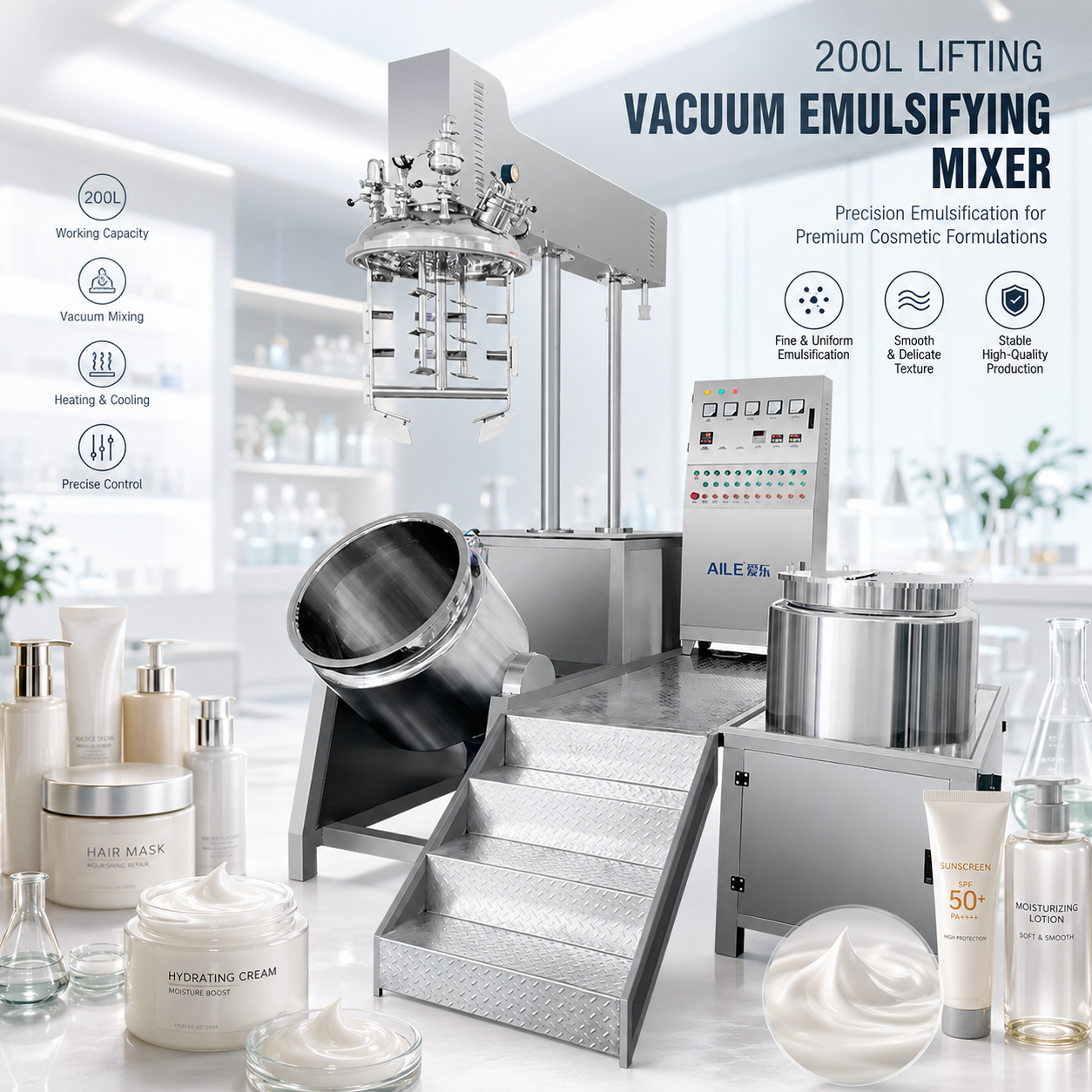
Not every shaving foam recipe requires identical processing parameters; lighter formulas may demand lower agitation speeds to protect surfactant integrity. For facilities preparing high-stability emulsions requiring strict temperature control and air-free batching, utilizing specialized Vacuum Emulsifying Mixers ensures the concentrate reaches the packaging line in uniform, pumpable condition.
3. Why Air Entrapment and Premature Foaming Matter
Micro-air bubbles trapped within the concentrate during processing or high-speed pumping are among the most frequent causes of unexplained filling deviations.
- Volumetric metering errors: Piston-based liquid dosing units meter by volume. When entrained air is present, the cylinder draws in a fluid-gas matrix rather than pure concentrate, leading to severe net-weight fluctuations.
- Premature lathering in the feed line: Excessive shear or fluid turbulence in supply pipes can trigger micro-foaming inside transfer manifolds. This creates spongy backpressure, erratic shut-off cycles, and dripping.
- Dissolved oxygen and package corrosion: Air introduced into the can prior to crimping introduces oxygen, which can compromise internal can coatings and promote long-term container degradation, particularly in water-heavy soap emulsions.
Preventing premature aeration requires optimizing pump transfer speeds, keeping pipe runs direct, and verifying that upstream deaeration aligns with formulation viscosity.
4. Liquid Filling Considerations
Filling the viscous shaving foam concentrate into open aerosol cans requires careful dosing control to maintain high hygiene and clean sealing surfaces.
Key engineering variables to evaluate include:
- Viscosity shifts across ambient temperatures: Soap-based emulsions often thicken when ambient workshop temperatures drop. Maintaining constant line temperatures helps preserve steady flow rates.
- Nozzle geometry and cut-off: Because the concentrate has clinging tendencies, filling nozzles must feature positive, drip-free mechanical shut-offs to prevent fluid from stringing onto the can rim. Any residual concentrate on the 1-inch opening compromises subsequent valve sealing.
- Sub-surface vs. top filling: Lowering the nozzle into the can during the stroke reduces air turbulence and prevents liquid splashing against internal sidewalls.
- Metering accuracy verification: Actual concentrate batches must be run through the doser to set optimal cycle times and stroke speeds.
For pilot lines, small-batch runs, or flexible cosmetic production suites, integrating a robust Semi-Automatic Aerosol Filling Machine allows technicians to dial in stroke speeds, nozzle depths, and cut-off timing to match the formulation's flow properties.

5. Valve Crimping and Package Compatibility
Once the liquid concentrate is inside the container, the 1-inch aerosol valve is placed onto the can opening and crimped to establish a leak-tight seal before propellant injection.
Valve crimping is never an isolated mechanical step; it functions as an integrated mechanical assembly:
- System integration: The tinplate or aluminum can opening, the valve mounting cup thickness, the gasket polymer (e.g., Buna-N, Neoprene), and the crimping collet must match precisely.
- Collet settings and deformation: Crimp diameter and crimp depth settings govern how the gasket compresses against the can curl. Over-crimping cuts or distorts the elastomer gasket, while under-crimping creates micro-leak paths under internal pressure.
- Diagnosing leakages holistically: When cans fail weight-loss tests or water-bath leak checks, the issue is not always crimper wear. Inconsistencies in can curl radius, variations in mounting cup hardness, or concentrate residue trapped between the gasket and curl can all degrade the seal.
- Physical container verification: Every packaging combination must undergo mechanical calibration with empty and filled cans to confirm seal integrity before proceeding to gas charging.
6. Propellant Selection and Foam Performance
In traditional aerosol shaving foam, propellants serve a dual purpose: they provide the mechanical drive to expel the liquid, and they act as the expansion agent that generates the lather.
- Liquefied propellants in emulsion: Hydrocarbon blends (Propane/Isobutane/Butane or LPG) are the industry standard for traditional shaving foams. When shaken, a small portion of the liquefied gas dissolves into or emulsifies with the soap solution. As the concentrate is sprayed into atmospheric pressure, the liquefied propellant immediately boils and vaporizes, expanding the emulsion into rich lather.
- Pressure curves and discharge stability: Unlike compressed gases (such as N₂ or CO₂) whose pressure decays continuously as the product is emptied, liquefied gases maintain relatively constant internal vapor pressure from the first actuation to the last, provided the liquid propellant phase remains present.
- DME vs. LPG considerations: Dimethyl Ether (DME) exhibits water solubility and acts as a solvent, which alters emulsion viscosity, stability, and gasket swelling behavior. LPG remains non-polar and separates unless properly agitated. The choice between them dictates formulation adjustments and seal polymer selection.
To explore chemical and physical trade-offs in aerosol gas selection, consult our comparative technical guide on LPG vs DME vs N₂ vs CO₂ Aerosol Propellants. When configuring propellant dosing stations, utilizing purpose-built Semi-Automatic Aerosol Propellant Gas Filling Machines ensures safe through-the-valve gas metering with precise volumetric regulation.
7. Why Valve and Actuator Matter to Final Foam
Even with an ideal formulation, precise liquid weight, and correct gas dosing, shaving foam quality can still degrade if the valve and actuator specifications are misaligned with the fluid dynamics.
- Valve flow passages: Shaving foam typically requires continuous flow valves without restrictive internal vapor taps (which are common in fine spray aerosols). Restricted stem orifices can cause premature shear, collapsing the foam before it exits.
- Actuator passage and expansion chambers: Shaving foam actuators feature wide internal channels and specialized discharge spouts. They are designed to allow the expanding propellant-concentrate mix to develop full foam structure without excessive turbulence.
- Discharge rate control: If the actuator orifice is too narrow, the product emerges as an aggressive, sputtering jet rather than an expanding lather. Conversely, an oversized passage can cause dripping and slow, sloppy output.
- Tactile user experience: Foam density, firmness, spreadability, and collapse resistance depend on the balance between valve orifice diameters, actuator spout design, propellant percentage, and formula viscosity.

8. What Should Be Tested Before Finalizing the Machine?
Because shaving foam behaves as an interdependent chemical and mechanical system, equipment configurations must never be finalized based solely on generic specifications or liquid-water assumptions.
Before finalizing machine tooling, nozzle diameters, and charging volumes, technical teams should validate:
- Bulk formulation behavior: Confirm concentrate stability across resting and agitated states, checking for air release and viscosity stability under shear.
- Package dimensional compatibility: Verify can curl dimensions against valve cup specifications and selected gasket materials.
- Liquid nozzle clearance: Test concentrate filling on physical container samples to establish clean shut-off dynamics without stringing.
- Propellant charging and recovery: Check valve stem opening forces and seal recovery during high-pressure through-the-valve gassing.
- Dispensing and expansion performance: Evaluate foam structure, discharge rate, and density after cans achieve thermal equilibrium in 20°C–25°C storage.
For engineering teams moving from formulation trials into plant planning, explore our dedicated Shaving Foam Aerosol Filling Application Guide and review the Automatic Shaving Foam Filling Machine technical specifications. For broader machinery frameworks, refer to our Standard Aerosol Filling Line architecture and pre-shipment protocols in the Aerosol Filling Line FAT Checklist.
9. FAQ About Shaving Foam Aerosol Filling
Why does shaving foam require different filling considerations from body spray or air freshener?
Body sprays and air fresheners are low-viscosity, solvent- or alcohol-based solutions that atomize into fine airborne droplets via mechanical breakup actuators. Shaving foam is a high-viscosity soap or surfactant emulsion engineered not to atomize, but to expand into a stable lather. Its concentrate is prone to shear thinning, temperature-dependent viscosity shifts, and foaming during liquid filling, requiring clean shut-off liquid nozzles, air-free metering, and valve-actuator assemblies engineered specifically for continuous emulsion expansion.
Does every shaving foam formula require vacuum emulsification?
Not every formulation demands full vacuum emulsification, but many traditional recipes based on fatty acid saponification benefit significantly from it. If a formula requires intense agitation or high-shear rotor-stator blending to achieve emulsion stability, vacuum processing prevents air from becoming whipped into the bulk. If a formula uses pre-neutralized, cold-process surfactant blends with low foaming tendencies during slow blending, standard planetary or anchor mixing may suffice.
Why can air bubbles affect shaving foam filling accuracy?
Aerosol liquid filling cylinders meter concentrate by volumetric displacement. If microscopic air pockets are entrained in the product, the piston draws a compressible liquid-gas mixture rather than a continuous liquid phase. This leads to inconsistent net weights, erratic shut-off cut-offs, dripping around the can opening, and unwanted oxidation inside the sealed container.
How does propellant choice affect shaving foam performance?
Liquefied propellants such as hydrocarbon blends (LPG) remain partially emulsified in the liquid concentrate under pressure. When discharged into atmospheric pressure, the propellant flashes into vapor, instantly turning the liquid stream into a dense lather while maintaining steady internal pressure throughout the can's lifecycle. Alternative propellants like Dimethyl Ether (DME) exhibit higher water solubility and polar characteristics, which directly affect emulsion viscosity, can coating compatibility, and valve gasket selection.
Can the same filling machine be used for different shaving foam formulations?
Yes, provided the machine is engineered with sufficient adjustability. Different formulations vary in viscosity, foaming sensitivity, and target can volumes. Accommodating multiple SKUs requires adjustable piston stroke lengths, interchangeable liquid nozzle tips with positive shut-off seals, variable conveyor and indexing speeds, and adaptable propellant metering cylinders.
Why should cans, valves, actuators, and product samples be tested before machine configuration?
Shaving foam packaging acts as an interdependent mechanical and chemical system. The valve cup must crimp securely against the specific can curl radius; the liquid nozzle must match the can neck opening without splashing; and the internal valve orifices and actuator spout must be physically tested with the actual concentrate-propellant blend to verify foam density and spray rate. Testing authentic components prevents costly tooling rework and ensures the line achieves target filling accuracy from day one.
Engineering Action Plan
- Formulation & Process Benchmarking: Send 2–3 liters of actual concentrate to AILE engineers to analyze shear-viscosity profiles and confirm whether standard piston heads or heated/jacketed dosing is required.
- Package Seal Validation: Provide 50 sample cans and valves to perform mechanical crimping deformation tests and establish baseline crimp diameter/depth specifications.
- Propellant Dosing Verification: Validate target can pressure and foam density using your selected propellant ratio (LPG vs. DME) before signing off on valve and actuator component selections.