Choosing a lubricant aerosol filling line is not simply a matter of buying the fastest machine available.
For products such as penetrating oil, anti-rust spray, silicone lubricant spray and automotive maintenance aerosols, the right equipment depends on your required output, number of SKUs, filling volume, propellant, available workshop space and future expansion plans.
For most lubricant aerosol projects, the equipment can be divided into three production levels:
- Semi-automatic filling: approximately 500–700 cans/hour
- Standard automatic filling line: approximately 2,400–3,600 cans/hour
- High-speed automatic line: approximately 4,800–7,200 cans/hour
Understanding the difference between these three options can help manufacturers avoid both under-investing and buying unnecessary capacity.
Quick Comparison: Which Lubricant Aerosol Filling Solution Fits Your Project?
| Production Solution | Typical Capacity | Best Suited For |
|---|---|---|
| Semi-Automatic | 500–700 cans/hour | Start-ups, small batches, multiple SKUs and flexible production |
| Standard Automatic Line | 2,400–3,600 cans/hour | Regular commercial production and stable daily orders |
| High-Speed Line | 4,800–7,200 cans/hour | Large-volume manufacturing and continuous production |
The production speed is important, but it should not be the only factor considered.
A factory producing several lubricant aerosol formulas in small batches may benefit more from a flexible semi-automatic system, while a manufacturer running the same product continuously may achieve better efficiency with an automatic or high-speed line.

1. Semi-Automatic Lubricant Aerosol Filling Machine
A semi-automatic lubricant aerosol filling system is normally suitable for manufacturers entering aerosol production or producing relatively small batches.
AILE's semi-automatic configuration can reach approximately 500–700 cans per hour depending on the product, filling volume and operator workflow.
The main operations normally include:
- Liquid filling
- Aerosol valve placing
- Valve crimping
- Propellant filling
Semi-automatic equipment is especially useful when a factory produces several SKUs or changes products frequently.
Compared with a complete automatic line, the equipment is easier to arrange in a smaller production area and requires a lower initial investment.
It can be a practical choice for:
- New lubricant aerosol projects
- Trial production
- Small or medium orders
- Multiple lubricant formulas
- Frequent product changeovers
- Markets where future demand is still being tested
However, semi-automatic production requires more operator involvement. When daily production volume continues to increase, labor handling and production consistency may gradually become limiting factors.
For manufacturers expecting stable long-term growth, moving directly to an automatic line may provide better production efficiency.
2. Standard Automatic Lubricant Aerosol Filling Line
For established commercial production, the standard automatic lubricant aerosol filling line is usually the most balanced option.
AILE's standard automatic line has a typical production capacity of approximately 2,400–3,600 cans per hour.
The production process can integrate:
- Automatic can conveying
- Liquid filling
- Aerosol valve placing
- Valve crimping
- Propellant filling
- Downstream inspection and packing equipment
Depending on the final project, equipment such as a water bath leakage tester, online checkweigher, actuator pressing machine, cap pressing machine, coding system and packing equipment can also be integrated.
For lubricant aerosol applications, this level of automation is suitable for products such as:
- Penetrating oil aerosol
- Anti-rust spray
- Multi-purpose lubricant spray
- Silicone lubricant spray
- Automotive maintenance aerosol
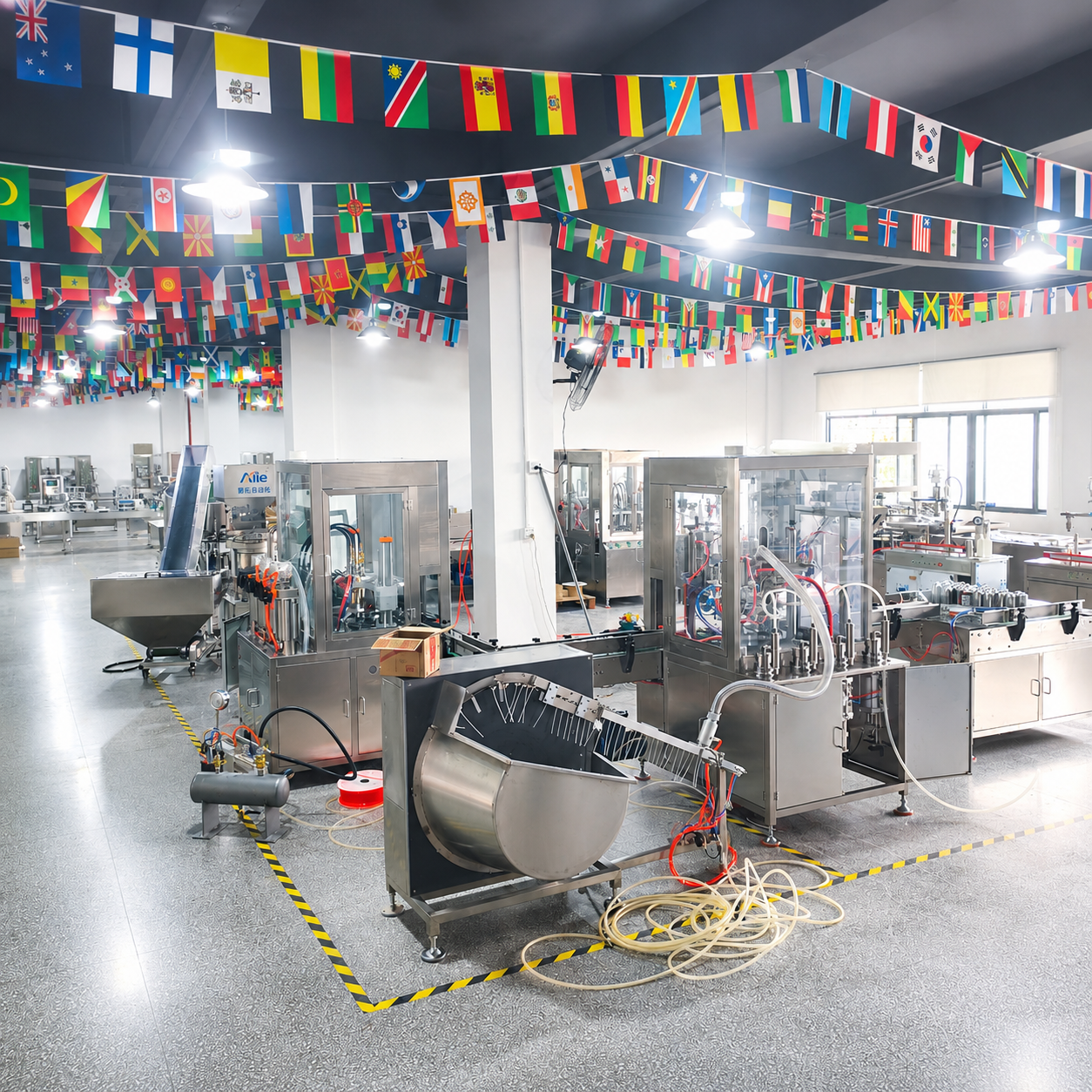
A complete aerosol filling line may have a total line length of approximately 21 meters, depending on the selected equipment.
However, the line does not always need to be arranged in a straight layout.
AILE can design the production line in straight, U-shaped or L-shaped layouts according to the customer's workshop.
This can help factories use their available floor space more efficiently.
For a complete automatic aerosol filling project, a workshop area of approximately 100 m² or more is generally recommended. The final requirement depends on the line configuration, auxiliary equipment, operator access and workshop layout.
For many lubricant aerosol manufacturers, the standard automatic line offers the best balance between:
- Production capacity
- Automation
- Investment
- Workshop requirements
- Future production growth
This is why the 2,400–3,600 BPH configuration is commonly suitable for regular commercial aerosol production.
3. High-Speed Lubricant Aerosol Filling Line
When production demand reaches several thousand cans per hour on a continuous basis, a high-speed aerosol filling line becomes more suitable.
AILE high-speed aerosol production lines can be configured for approximately 4,800–7,200 cans per hour, depending on the complete line design and product requirements.
High-speed systems are more suitable when:
- Production volumes are consistently high
- The same or similar products are manufactured for long runs
- Large customer orders require continuous output
- Labor efficiency becomes increasingly important
- The factory plans for long-term capacity expansion
AILE has supplied high-speed lubricant aerosol production projects to markets including Argentina and Australia.
For high-output projects, individual filling modules may also operate at higher speeds. For example, AILE's high-speed liquid filling module can reach approximately 100–120 cans per minute under suitable conditions.
However, this should not be interpreted as the guaranteed speed of the complete aerosol filling line.
The final line capacity depends on all production stations, including liquid filling, valve handling, crimping, propellant filling, inspection and downstream equipment.
For this reason, the complete line should always be designed according to the required final production output rather than the speed of one individual machine.
Semi-Automatic or Automatic: Which Should You Choose?
There is no single production capacity that is suitable for every lubricant aerosol manufacturer.
A simple way to choose is to start with your expected production volume.
Choose Semi-Automatic if:
- You are starting aerosol production
- Your batch sizes are relatively small
- You manufacture several different SKUs
- Product changeovers are frequent
- Production flexibility is more important than maximum output
- You want to control the initial equipment investment
Choose a Standard Automatic Line if:
- You already have stable customer orders
- Daily production volume is increasing
- You need more consistent output
- You want to reduce manual handling
- You expect production demand to continue growing
For many commercial lubricant aerosol factories, 2,400–3,600 cans/hour provides a practical balance between production efficiency and investment.
Choose a High-Speed Line if:
- You have large and stable production orders
- Continuous production is required
- Your main SKUs are relatively stable
- Production capacity is the main priority
- You are planning for large-scale or long-term expansion
Higher speed is not automatically better. A factory producing many different lubricant formulas in short batches may actually operate more efficiently with a lower-capacity but more flexible production system.
Workshop Space Is Also Part of Equipment Selection
Production capacity should always be considered together with workshop conditions.
A complete aerosol line may include:
- Filling machines
- Conveyors
- Water bath leakage testing
- Checkweighing
- Actuator and cap pressing
- Coding
- Packing equipment
- Operator access areas
If workshop length is limited, the line can often be arranged in a U-shaped or L-shaped configuration instead of a straight 21-meter layout.
This is why providing a workshop drawing before final equipment selection is useful. The production line can then be designed around the available building rather than forcing the factory to adapt to a fixed machine layout.
Information to Provide Before Choosing a Lubricant Aerosol Filling Line
Before selecting equipment, manufacturers should prepare the following information:
- Required production capacity
- Aerosol can diameter and height
- Product filling volume
- Lubricant formulation
- Approximate product viscosity
- Aerosol valve specification
- Propellant type
- Number of different SKUs
- Required automation level
- Available workshop dimensions
For lubricant products containing special additives or higher-viscosity formulations, providing a product sample or video of the material flow can also help confirm the most suitable filling configuration.
Frequently Asked Questions
What production capacity is suitable for a new lubricant aerosol factory?
For small-scale or early-stage production, a semi-automatic system of approximately 500–700 cans/hour is often sufficient.
If regular commercial orders are already available, a 2,400–3,600 cans/hour automatic line may provide better long-term efficiency.
Is a high-speed line always better than a standard automatic line?
No. A high-speed line is most suitable for stable, large-volume production. If a manufacturer has many SKUs or frequent product changes, a standard automatic or semi-automatic system may provide greater flexibility.
How much workshop space is required for an automatic aerosol filling line?
A complete line can be approximately 21 meters long in a straight arrangement.
A workshop area of around 100 m² or more is generally recommended, although the final requirement depends on the equipment configuration and operating space. U-shaped and L-shaped layouts can also be designed when workshop length is limited.
Can the same line fill different lubricant aerosol products?
In many projects, the same line can be configured for several lubricant aerosol products as long as the can, valve, filling range and formulation are within the equipment's operating range. The exact configuration should be confirmed based on the actual products.
Choosing the Right Capacity for Your Project
The best lubricant aerosol filling line is not necessarily the fastest one. It is the line that matches your real production demand, workshop conditions, product range and future growth plan.
AILE can provide semi-automatic, standard automatic and high-speed aerosol filling solutions according to the required capacity, lubricant formulation, aerosol can, valve and propellant.
If you are planning a lubricant aerosol production project, send us your target capacity, can size, filling volume, product information and propellant. We can recommend a suitable production configuration based on your actual requirements.