When requesting a quotation for an aerosol filling machine, simply asking:
“How much is an aerosol filling machine?”
is usually not enough to receive an accurate proposal.
The final machine configuration depends on the actual product, packaging materials, filling volume, valve, propellant, required production capacity and level of automation. Two customers asking for an “aerosol filling machine” may need completely different solutions.
Providing the correct project information at the beginning helps the manufacturer:
- Recommend the right machine type
- Avoid oversized or undersized equipment
- Confirm can and valve compatibility
- Select the correct propellant filling configuration
- Calculate the required production capacity
- Plan optional downstream equipment
- Prepare a more accurate quotation
- Reduce technical changes after the order is placed
This checklist explains what information should be prepared before requesting an aerosol filling machine quotation.
1. Product Name and Application
Start with the actual product you want to manufacture. Examples include:
- Lubricant spray
- Penetrating oil
- Hairspray
- Deodorant
- Body spray
- Shaving foam
- Insecticide
- Air freshener
- Spray paint
- Bag-on-Valve products
- MDI aerosols
- Other technical aerosols
The product name gives the machine manufacturer an initial understanding of the likely filling process. However, the product name alone is not enough. For example, two lubricant aerosols may have different viscosities, additives, filling volumes or propellants.
If you are not yet sure which type of equipment is suitable for your product, read our Aerosol Machine Selection Guide.
2. Basic Formulation Information
The manufacturer does not always need your full confidential formula at the quotation stage. However, basic product information is important. Useful information includes:
- Approximate viscosity
- Whether the product is water-based, solvent-based or oil-based
- Whether it contains particles or suspended materials
- Whether continuous mixing is required
- Whether the product foams easily
- Whether special product-contact materials may be required
This helps determine the appropriate liquid filling configuration. For unusual products, a material sample may be requested later for machine testing. The purpose is not to copy the formulation; it is to make sure the filling system can handle the actual material.
3. Liquid Filling Volume
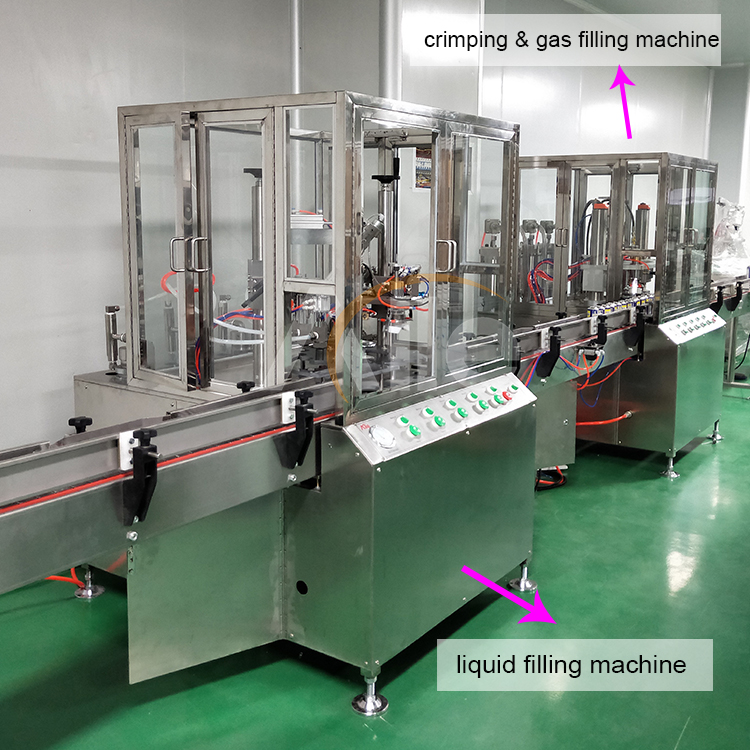
Provide the target liquid filling amount for each aerosol can, such as 100 ml, 200 ml, 300 ml, or 500 ml. If the project includes several SKUs, provide the filling volume for each size. This is important because the filling cylinder or dosing system must match the required volume range.
A machine designed around one filling range may not provide the same performance across a completely different range. When requesting a quotation, provide:
- Minimum liquid filling volume
- Maximum liquid filling volume
- Most common production volume
This allows the manufacturer to evaluate whether one machine can cover all planned SKUs.
4. Propellant Type and Filling Amount
The propellant is one of the most important pieces of information in an aerosol filling project. Common propellants include LPG, DME, Nitrogen (N₂), and Carbon dioxide (CO₂).
You should provide:
- Propellant type
- Required propellant filling amount
- Whether more than one propellant may be used
Different propellants can require different gas supply, pressure-control and safety configurations. If you are still comparing LPG, DME, nitrogen and CO₂, read our Propellant Equipment Comparison: LPG vs DME vs N₂ vs CO₂. For flexible standalone or semi-automatic gas charging, see the Semi-Automatic Aerosol Propellant Gas Filling Machine.
5. Aerosol Can Dimensions
Provide the actual aerosol can dimensions. The most important dimensions are:
- Can diameter
- Can height
- Can material
- Can shape if non-standard
For example, one AILE automatic aerosol filling line may be configured for cans approximately with a diameter of 35–70 mm and a height of 80–300 mm. These values are model-specific and should not be treated as a universal range for every machine.
If several can sizes will run on the same line, list all of them. The manufacturer can then evaluate guide-rail adjustment, can positioning, required change parts, conveyor compatibility, and filling-head positioning.

6. Valve Specification
The aerosol valve should be confirmed before the machine configuration is finalized. Useful information includes valve diameter, valve type, mounting cup specification, stem configuration, dip tube details, and actual valve samples if available.
Many standard aerosol projects use a 1-inch (25.4 mm) valve, but special valves may require different machine settings or tooling. For quotation purposes, a valve drawing can be useful. Before machine production or Factory Acceptance Testing (FAT), physical samples are strongly recommended.
7. Actuator, Cap and Other Packaging Components
If the production line will include downstream packaging automation, provide details for actuator or spray button, overcap, trigger actuator, extension straw, and special packaging accessories. This information affects whether the project requires automatic actuator pressing, cap pressing, straw application, additional conveyor sections, or special vibratory feeding systems.
If the quotation only covers the core filling process, these items may not be necessary. But if you want a complete automatic line, they should be included from the beginning.
8. Required Production Capacity
Do not simply ask for “the fastest machine.” Provide your realistic target output. AILE commonly supplies different production levels:
| Production Level | Typical Capacity |
|---|---|
| Semi-Automatic | 500–700 cans/hour |
| Standard Automatic | 2,400–3,600 cans/hour |
| High-Speed Automatic | 4,800–7,200 cans/hour |
The most suitable level depends on your current order volume, number of SKUs, frequency of product changes, available labor, and future production plans. If you are still deciding between semi-automatic and automatic equipment, see our Aerosol Machine Selection Guide.
9. Do You Need a Single Machine or a Complete Production Line?
This should be clear in the RFQ. You may only need liquid filling, valve crimping, and propellant filling. Or you may need a complete production line including can conveying, liquid filling, valve placing, crimping, propellant filling, leak testing, checkweighing, actuator pressing, cap pressing, coding, and packing.
If you are not sure what equipment should be included in a full line, read our Complete Production Line Equipment Checklist. For integrated automatic production systems, browse AILE's Aerosol Filling Lines. For individual machine options, see our Aerosol Filling Machines.
10. Required Downstream Equipment
If you are requesting a complete line, tell the manufacturer which downstream processes are required. Possible options include:
- Water bath leak testing
- Online checkweighing
- Actuator pressing
- Cap pressing
- Coding
- Extension straw application
- Packing equipment
If you are unsure, you can also explain the required finished package and allow the manufacturer to recommend the necessary downstream modules.
11. Workshop Dimensions and Layout
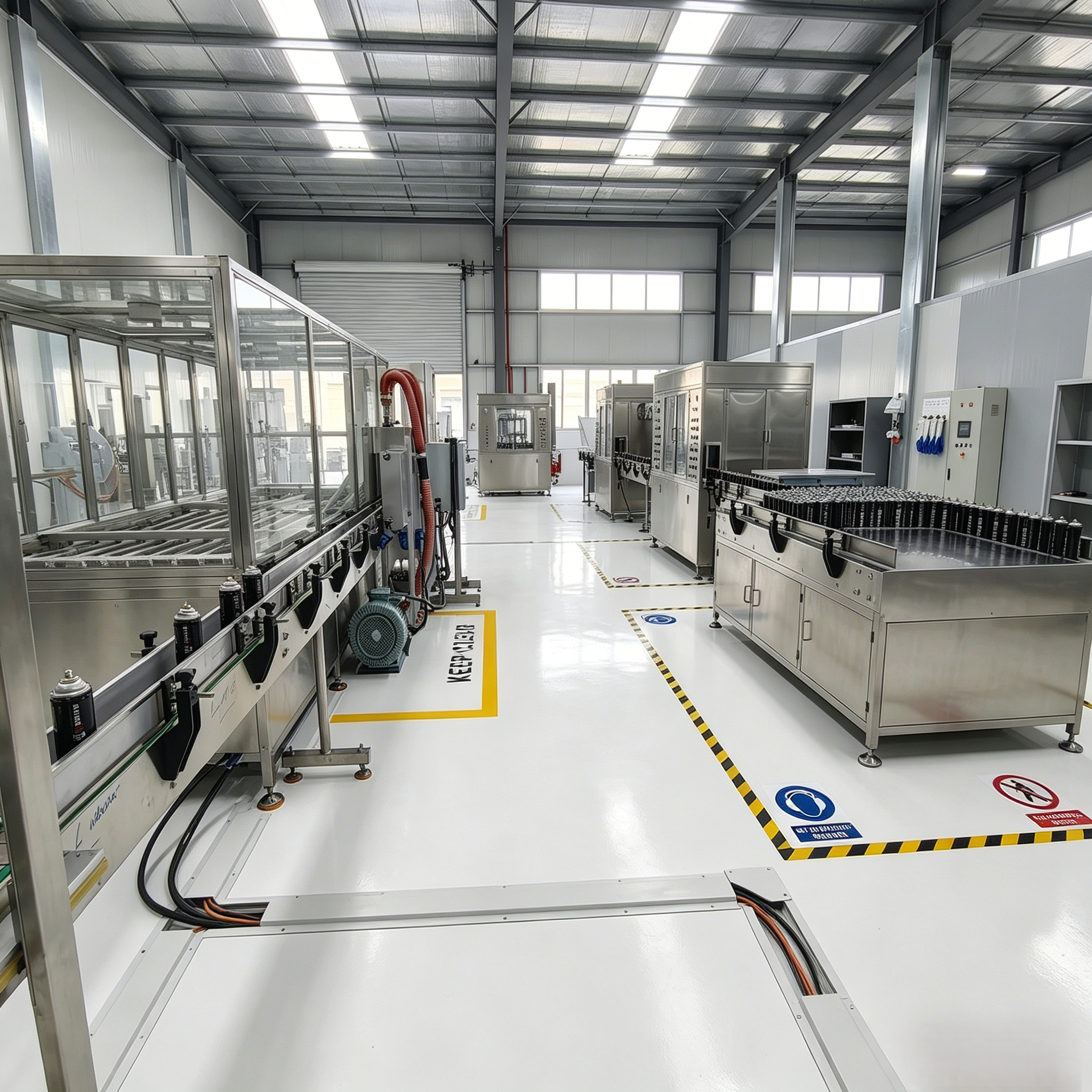
For automatic production lines, workshop dimensions can directly affect the final equipment layout. Provide available workshop length, width, ceiling height, columns or fixed obstacles, preferred machine orientation, and total available production area.
A complete straight aerosol filling line may reach approximately 21 meters, depending on the final configuration. If straight-line space is limited, AILE can also design straight, U-shaped, or L-shaped layouts. For a complete aerosol production project, a workshop area of approximately 100 m² or more is often recommended. Providing a floor plan makes the quotation and technical proposal much more useful.
12. Voltage, Frequency and Destination Country
Always include the destination country and provide the required electrical standard, such as 220V, 380V, 50Hz, 60Hz, single-phase or three-phase. The destination country also matters because electrical codes, certification standards, explosion-proof requirements, and international logistics/installation planning differ by region.
13. Required Safety or Certification Requirements
If your project requires specific certification or safety documentation, state this clearly in the RFQ, such as CE requirements, ATEX explosion-proof configurations, customer-specific factory standards, or full machine qualification documentation.
14. How Many SKUs Will Run on the Same Equipment?
Tell the manufacturer how many product formulations, can sizes, filling volumes, valve types, actuators, and caps will run on the machine. A line producing one stable SKU is very different from a factory changing between multiple products every day. The number of SKUs directly affects changeover downtime, required change parts, and overall system flexibility.
Quick RFQ Checklist
Before sending your quotation request, prepare the following specifications:
| RFQ Item | Information to Provide |
|---|---|
| Product | Product name and application |
| Formulation | Basic viscosity and product characteristics |
| Liquid Fill | Minimum, maximum, and normal filling volume |
| Propellant | LPG, DME, N₂, CO₂, or other gas types |
| Gas Fill | Required propellant filling amount/weight |
| Aerosol Can | Material (tinplate/aluminum), diameter, and height |
| Valve | Valve size (standard 1" or special) and specification |
| Actuator / Cap | Samples or drawings if automation is required |
| Capacity | Required cans/hour output target |
| Automation | Semi-automatic or fully automatic line |
| Downstream Equipment | Water bath, checkweigher, cap presser, coding, packing |
| SKUs | Number of product and packaging formats running on the line |
| Workshop | Available floor dimensions (L × W × H) or plant drawing |
| Electrical | Voltage, frequency (50/60Hz), and power phase |
| Destination | Destination country & discharge port |
| Certification | CE compliance, explosion-proof standards, or factory audits |
What Happens After You Send the RFQ?
Once the basic project information is available, the machine supplier can evaluate the machine type, filling-system setup, propellant gas dosing system, production capacity, packaging compatibility, optional downstream units, workshop layout, electrical specs, and final technical proposal.
For a serious aerosol production project, the more useful document is a detailed technical proposal linked to the commercial quotation. This allows the buyer to evaluate machine scope, capacity, included stations, change parts, utilities, and testing requirements.
Should You Send Physical Samples Before Ordering?
For many standard projects, drawings and specifications are enough for the initial quotation. However, before machine production or final Factory Acceptance Testing (FAT), AILE normally recommends providing actual packaging samples, including cans, valves, actuators, caps, and straws. This allows AILE to test machine tooling with real components, verifying can clamping, crimping tightness, gas filling seals, and cap installation.
Frequently Asked Questions: RFQ & Quotation Preparation
Why can't a manufacturer give an immediate price from “I need an aerosol filling machine”?
An aerosol filling line is custom-engineered based on the chemical formulation, can dimensions, valve specifications, propellant gas type, and output speed. A semi-automatic tabletop unit producing 500 cans/hour has completely different engineering and cost parameters than a high-speed automatic explosion-proof line running 6,000 cans/hour with downstream packaging.
Is a photo of my aerosol can enough to quote an automatic line?
While a photo helps identify the product category, it does not reveal critical dimensions (diameter, total height, neck opening), valve mounting cup tolerances, filling volume, propellant type, or speed requirements. Technical drawings or sample dimensions are essential for an accurate technical proposal.
Can one aerosol filling machine handle multiple can sizes and SKUs?
Yes. AILE aerosol machines can run multiple can sizes using quick-change star wheels, adjustable guide rails, and modular tooling. Providing the exact dimensions of all planned SKUs in your RFQ ensures that all necessary changeover parts and adjustments are engineered into the initial proposal.
What if our workshop cannot accommodate a 21-meter straight production line?
AILE can customize conveyor configurations into L-shaped or U-shaped production layouts to fit compact or irregular workshop floor plans without sacrificing output efficiency or safety buffer zones.
Common RFQ Mistakes That Delay an Accurate Quotation
- “I Need an Aerosol Filling Machine. Please Send Price.” — Lacks product, can dimensions, propellant, and output parameters needed to select equipment.
- Sending Only a Finished Product Photo — Fails to specify exact physical tolerances, material thickness, or pressure specs.
- Asking for the Fastest Line Without Expected Output — Causes over-engineering and inflated initial capital budgets.
- Mentioning Special Requirements After Quotation Approval — Late changes to voltage, explosion-proof zoning, or valve tooling cause redesign delays and price adjustments.
From Price Quotation to a Technical Proposal
An accurate aerosol filling machine quotation should include more than the equipment price. For a serious production project, the technical proposal should clearly define the recommended machine configuration, expected production capacity, applicable packaging range, optional downstream equipment, and major project requirements. When workshop dimensions and production requirements are available, AILE can evaluate the line layout and recommend a suitable straight, L-shaped, or U-shaped arrangement.
Related Aerosol Filling Equipment & Engineering Guides
- Propellant Filling Equipment: Explore the Semi-Automatic Aerosol Propellant Gas Filling Machine for LPG, DME, N₂ and CO₂ filling projects.
- Complete Aerosol Filling Lines: View AILE's Aerosol Filling Lines for integrated liquid filling, valve handling, crimping, propellant filling and optional downstream equipment.
- Bag-on-Valve Production: For BOV projects, see our Bag-on-Valve Filling Machine for flexible production or the Automatic Bag-on-Valve Aerosol Filling Line for continuous automatic production.
- How to Select the Right Machine: Read How to Choose an Aerosol Filling Machine for Your Production Needs if you are still comparing production capacity and automation levels.
- Complete Line Planning: Use our Complete Aerosol Filling Line Equipment Checklist to understand which core filling, inspection and downstream stations may be required.
- Propellant System Selection: Compare LPG vs DME vs N₂ vs CO₂ to understand how the selected propellant affects filling method, pressure control and equipment configuration.
Request a Technical Proposal for Your Aerosol Project
Send AILE your product details, can dimensions, valve specs, liquid filling volume, propellant type and filling amount, target production capacity, automation level, downstream equipment needs, workshop dimensions, and destination country. AILE will evaluate your project parameters and deliver an engineered machine configuration and official quotation.