
A deodorant aerosol production line typically includes liquid filling, valve placement, crimping, propellant charging, leak/weight inspection, actuator and cap assembly, coding, and final packaging. Line configurations range from semi-automatic setups (500–700 BPH) for flexible batches to fully automated rotary lines (2,400–3,600 BPH) for continuous commercial production.
Setting up a manufacturing line for antiperspirant deodorants or fragranced body sprays involves more than selecting a standard liquid filler. The final configuration must account for chemical formulation traits (such as alcohol carriers and active antiperspirant suspensions), container integrity, propellant dynamics, and downstream quality compliance.
1. Complete Deodorant Aerosol Production Line: Core Modules Explained
A modern deodorant & body spray filling machine system operates as a synchronized train of mechanical stations. Each station handles a distinct physical phase of aerosol assembly:
1.1 Liquid Product Preparation & Precision Liquid Filling
The first mechanical stage doses the bulk liquid formulation into open metal containers (typically 35–65 mm diameter aluminum or tinplate cans, with liquid filling volumes often spanning 50 ml to 200 ml).
- Material Compatibility: Wetted contact parts typically utilize SUS304 or SUS316L stainless steel depending on the active chemistry and carrier solvents.
- Dosing Mechanism: Volumetric piston cylinders or positive-displacement dosing valves deliver liquid doses with repeatable precision (typically within ±1%). For alcohol-based and high-solvent body sprays, liquid seals must maintain dimensional stability to prevent volumetric drift.
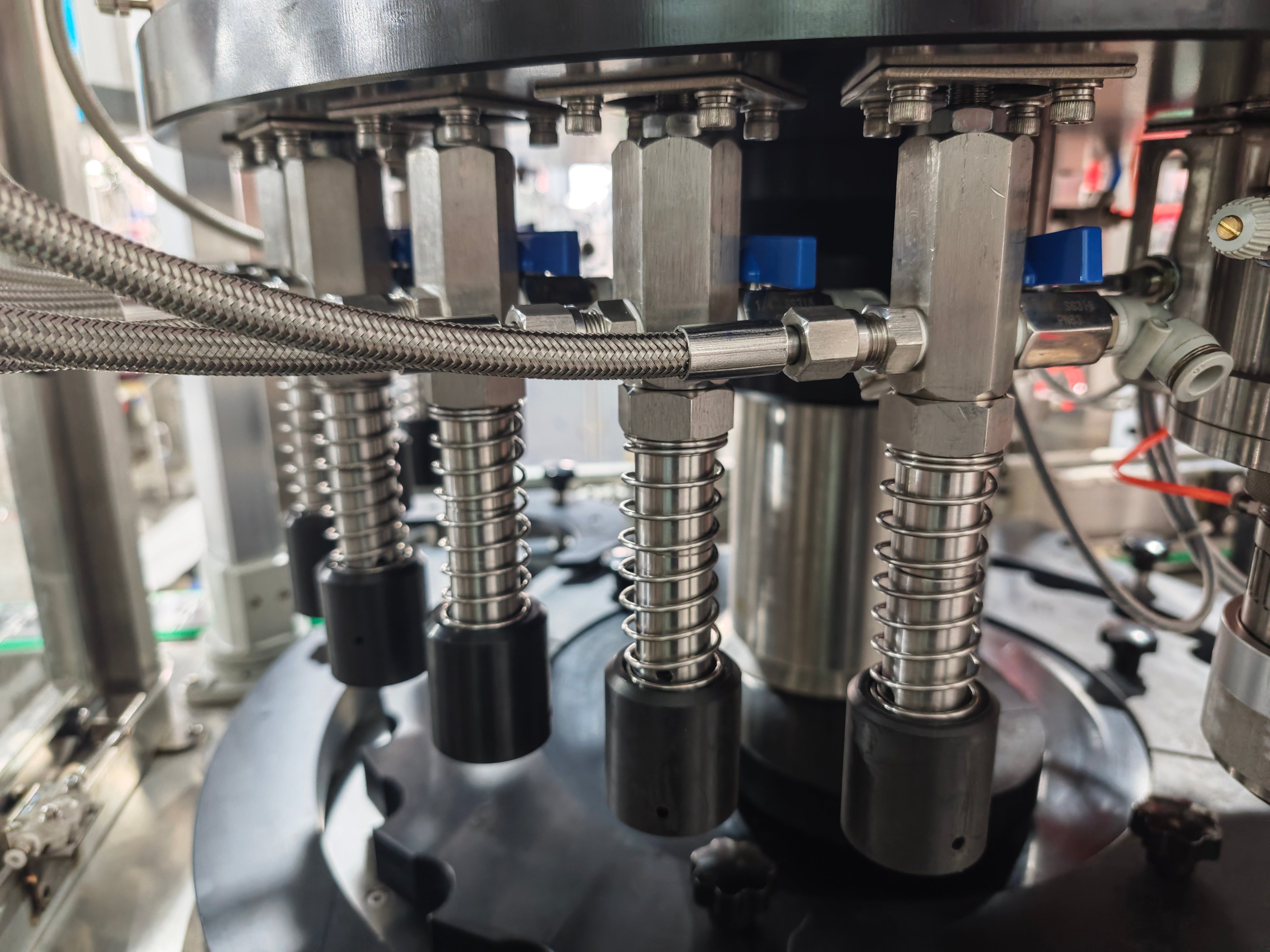
1.2 Valve Placing & High-Precision Crimping
Once the liquid is charged, standard 1-inch (25.4 mm) aerosol valves are positioned into the can openings.
- Automated Valve Insertion: Vibratory bowl sorters orient and seat the valve dip tubes into the containers without damaging the internal dip tube curve.
- Crimping Station: An expanding crimping collet engages the valve cup within the container neck. Precise crimping diameter (e.g., 27.1–27.3 mm) and crimp depth (e.g., 5.0–5.2 mm) create a hermetic seal capable of holding internal pressures exceeding 0.8–1.2 MPa after gassing.
1.3 Propellant Gas Charging
Gaseous propellant is injected into the container through the crimped valve under high pressure using metering cylinder heads.
- Propellant Options: Depending on brand preference and regional safety profiles, lines inject liquefied hydrocarbon gases (LPG), dimethyl ether (DME), or compressed gases like nitrogen (N2). Propellant selection directly determines the metering cylinder configuration and the workshop safety layout. For engineering distinctions between these mediums, consult our guide on LPG vs DME vs N² vs CO² aerosol propellants.
- For initial or pilot operations utilizing standalone gassing stations, standalone pneumatic units such as a semi-automatic aerosol propellant gas filling machine isolate gas handling to dedicated exhaust zones.
1.4 Downstream Inspection & Final Packaging Units
- Dynamic Checkweigher: Positioned after propellant charging to verify the total weight of every can (liquid + container + valve + gas). Cans outside target tolerances are automatically rejected.
- Water Bath Leak Tester: Commonly used to verify container integrity and detect micro-leakage through crimped joints or valve stems under elevated bath temperatures (typically ~50°C). Final leak testing options and inspection protocols depend on applicable market regulations and your facility’s internal quality-control system.
- Actuator Presser & Cap Presser: Robotic or pneumatic pressing heads mechanically feed and seat aerosol spray buttons (actuators) and protective overcaps onto the container neck without triggering discharge.
- Marking & Accumulation: Continuous inkjet or laser coders print batch numbers and expiration dates on can domes before units feed onto rotary collection tables for case packing.
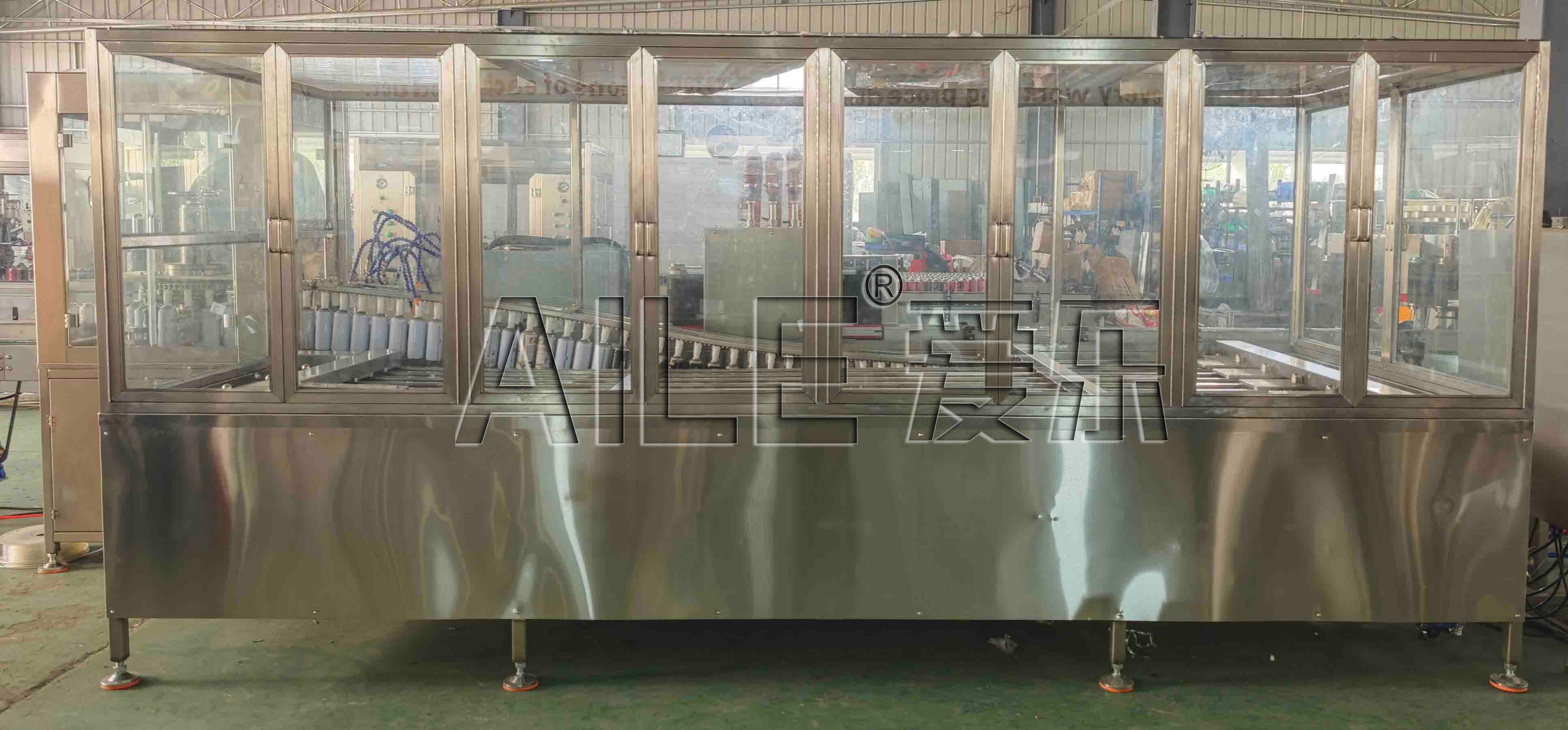
2. Capacity & Automation Selection: Semi-Automatic vs. Automatic Line
Selecting between semi-automatic and continuous automated lines depends on planned SKU variety, factory footprint, and shift targets.
2.1 Semi-Automatic Setup (Pilot, Flexible & Small-Batch Production, 500–700 BPH)
A semi-automatic aerosol filling machine combines liquid dosing, crimping, and propellant charging on a unified pneumatic bench or individual operator-guided tables.
- Best for: R&D pilot labs, startup brands, or specialty manufacturers producing small batches across dozens of fragrance variations.
- Operation: Manual can placement with foot-pedal or pneumatic button activation. Output typically ranges from 500 to 700 cans per hour (BPH) per operator team.
2.2 Standard Automatic Production Line (2,400–3,600 BPH)
For commercial-scale manufacturing, an integrated standard aerosol filling line connects all core stations via continuous slat-chain conveyors.
- Best for: Established cosmetics brands, commercial contract packers, and facilities with sustained volume runs.
- Operation: Automated starwheel indexing or inline gating moves cans through multi-head liquid filling, automatic valve dropping, crimping, multi-head propellant gassing, and continuous checkweighing.
| Selection Factor | Semi-Automatic Setup | Standard Automatic Line |
|---|---|---|
| Nominal Output (BPH) | 500–700 BPH | 2,400–3,600 BPH |
| Primary Motion | Manual can transfer / Pneumatic table | Continuous linear or indexing conveyor |
| Operator Requirement | 2–3 operators | 1–2 line supervisors |
| SKU Changeover Time | 15–25 minutes | 45–90 minutes (starwheels & rails) |
| Footprint Requirement | Small (~15–30 m²) | Medium–Large (~80–150 m² with conveyors) |
| Best-Suited Phase | Product launch, pilot runs, high SKU mix | Dedicated contract filling, high-volume retail |
3. Five Real-World Engineering Pitfalls in Deodorant Aerosol Projects (And How to Avoid Them)
Engineering failures in aerosol lines rarely stem from basic mechanical breakdowns; they arise from unaddressed chemical interactions, particle dynamics, and workshop facility gaps.
3.1 Alcohol/Solvent Formulations vs. Product-Contact Seal Compatibility
Deodorants and fine-fragrance body sprays rely heavily on ethanol, denatured alcohol, carrier glycols, and synthetic fragrance oils.
- The Pitfall: Buyers often define their liquid simply as "deodorant liquid" without specifying solvent ratios. Different elastomers respond unevenly across chemical carriers. Incompatible O-rings or piston seals can experience volume swelling, polymer hardening, premature degradation, or dosing volume drift.
- The Engineering Fix: Before finalizing machine specifications, the equipment manufacturer must review the actual liquid formulation properties to confirm the chemical compatibility of all product-contact seals (such as NBR, EPDM, or FKM variants) and fluid delivery lines. When working with proprietary or complex fragrance solvents, pre-production immersion testing on seal samples is recommended.
3.2 Suspension & Particle Antiperspirants: Settling and Clogging Risks
Antiperspirant sprays differ fundamentally from clear body sprays because they frequently contain micronized active powders (such as aluminum chlorohydrate) suspended in carrier oils.
- The Pitfall: If treated as standard clear liquids, these suspensions begin settling inside dosing cylinders, delivery manifolds, and valve dip tubes during operational pauses. This results in uneven active ingredient ratios between cans, pipeline sedimentation, and valve-orifice clogs.
- The Engineering Fix: For suspension-type antiperspirant aerosols, the upstream mixing and liquid feeding system may require continuous agitation, recirculating loops, or specific product-handling adjustments to maintain particle uniformity during filling cycles.

3.3 Relying on Can Sizes Alone Without Testing Valve + Actuator Flow Paths
A container package may crimp cleanly and hold pressure, yet still fail during consumer actuation.
- The Pitfall: Buyers sometimes specify machine tooling based solely on container diameter and neck dimensions, leaving valve and spray actuator selection unverified until factory delivery. In high-powder antiperspirants, mismatched stem orifices or convoluted actuator flow paths cause product build-up, erratic spray patterns, or nozzle blockage.
- The Engineering Fix: Provide production-intent cans, 1-inch valves, and target spray actuators to your equipment builder prior to assembly. Validating mechanical crimp profiles and running test sprays under actual propellant pressures during pre-shipment inspections confirms line compatibility. Review our aerosol filling line FAT checklist to see how pre-shipment testing protocols prevent installation delays.
3.4 LPG/DME Safety: Workshop Layout & Hazardous-Area Compliance Cannot Be an Afterthought
Liquefied petroleum gas (propane/butane blends) and dimethyl ether remain common aerosol propellants, but both are flammable gases that require strict plant infrastructure.
- The Pitfall: Procuring an explosion-proof gassing machine does not automatically make the installation compliant. Operators sometimes discover too late that their facility lacks adequate exhaust ventilation, explosion-relief walls, gas detection grids, or safe buffer distances between bulk storage tanks and ignition sources.
- The Engineering Fix: If LPG or DME is used, the gas-filling area, mechanical ventilation, electrical enclosure ratings (such as EX-proof / ATEX standards), propellant storage, and separation distances should be designed according to applicable local hazardous-area and fire-safety regulations. Equipment manufacturers can confirm machine-side gas consumption, pneumatic interface specs, and charging enclosures, while the overall workshop civil engineering and gas house layout must be approved in accordance with local safety codes.
3.5 Focusing Solely on Nominal Machine Speed While Ignoring SKU Changeovers
A machine rated for high hourly output can underdeliver in real-world output if your business model demands frequent packaging adjustments.
- The Pitfall: Investing in an ultra-high-speed indexing line when your factory produces six different fragrance SKUs per day results in excessive downtime. Swapping guide rails, starwheels, bulk liquid lines, and actuator feeding chutes can consume hours of productive capacity.
- The Engineering Fix: For multi-fragrance deodorant production, the fastest machine is not always the most efficient machine if product changeover takes too long. Evaluate nominal capacity alongside cleaning cycles, washdown access, tool-less rail adjustments, and cylinder purge simplicity.
4. What Information to Prepare Before Requesting a Production Line Quotation
To configure an accurate machinery quote without repeated revision cycles, provide manufacturers with your core container and production parameters upfront.
Why Sending Physical Samples Is Essential Before Machinery Production
Supplying technical drawings is helpful, but physical samples of cans, valves, and actuators are critical before manufacturing begins:
- Crimping Collet Calibration: Minor variations in container neck curl radius alter crimping jaw clearances.
- Valve Sorter Tooling: Dip tube stiffness and valve cup stamped profiles affect automated feeding tracks.
- Actuator Pressing Chucks: Ergonomic or directional body spray actuators require custom-milled pressing chucks to prevent marring or accidental discharge during assembly.
For a detailed technical worksheet to streamline your procurement process, review our aerosol filling machine RFQ checklist.
5. Frequently Asked Questions About Deodorant Aerosol Production Equipment
Can the same aerosol production line fill both deodorant spray and hair spray?
Yes, provided the liquid delivery components and contact seals are compatible with both formulations. Because both products frequently use alcohol solvents and 1-inch valves, the same linear or rotary line can process both. However, operators must account for cleaning procedures between batches and verify that can diameter changes (e.g., swapping from 45 mm deodorant cans to 65 mm hair spray cans) are supported by quick-change starwheels and guide rails.
Why is leak testing important in a deodorant aerosol filling line, and what options are available?
Leak testing verifies container integrity and confirms that the crimped valve holds pressure under variable shipping and storage temperatures. The traditional industry standard is a continuous hot water bath tester that submerges filled cans to monitor for escaping gas bubbles. Modern lines may also incorporate alternative gas-detection sniffer systems or pressure-decay checks, depending on your facility's local regulatory framework and brand quality standards.
How much floor space is needed for a 2,400–3,600 BPH automatic deodorant aerosol filling line?
A complete automatic line—including can unscrambling tables, liquid dosing, crimping, propellant charging, water bath inspection, actuator/cap pressing, and collection conveyors—typically requires a linear footprint of approximately 18 to 25 meters in length and 2 to 3 meters in width. Additional clear buffer space must be maintained around the gas charging enclosure in compliance with local safety standards.
Does propellant choice affect aerosol filling equipment configuration?
Yes. Liquefied propellants like LPG and DME require high-pressure liquid metering pumps, explosion-proof pneumatic drive systems, and dedicated safety enclosures. Conversely, compressed gas systems like nitrogen (N2) utilize pressure-regulated gas-charging heads without liquid gas booster pumps. Liquid contact seals and gas metering seals must also be matched to the selected gas to prevent premature breakdown.
Why does nominal capacity differ from actual daily production output?
Nominal capacity represents the maximum mechanical cycle speed of the filling heads under ideal steady-state conditions. Actual daily output is influenced by operator loading speed, batch changeovers, nozzle wipe-downs, inline checkweigher reject rates, and raw material feeding consistency (such as unjamming tangled dip tubes or bent valve cups).
Optimize Your Deodorant Aerosol Production Setup
Whether planning an entry-level pilot installation or upgrading to a 2,400–3,600 BPH automated line, proper machinery selection balances liquid dosing precision, seal longevity, and compliant propellant handling.
Discuss your container dimensions, target capacity, and formulation requirements with an AILE engineering specialist to receive a detailed line layout and machinery proposal.